







Choosing between a natural diamond and a lab-grown diamond is one of the biggest decisions many couples make during the engagement ring process. As a jeweler who offers both options, our goal is not to convince you that one is universally better than the other, but to help you understand the differences so you can make the choice that fits your values, priorities, and budget.
If you're researching lab grown vs natural diamonds, wondering whether lab-grown diamonds are real, or comparing lab-grown diamond prices in Houston, this guide will answer the questions we hear most often from our clients.
Are Lab-Grown Diamonds Real Diamonds?
Yes. Lab-grown diamonds are real diamonds. They have the same chemical composition, crystal structure, and hardness as natural diamonds. Both are made of pure carbon and rank a 10 on the Mohs hardness scale, making them the hardest known natural substance. They can also be certified by respected laboratories just like natural diamonds.
Unlike simulants such as cubic zirconia or moissanite, lab-grown diamonds are genuine diamonds in every sense. The difference begins with their origin.
What Is the Difference Between Natural and Lab-Grown Diamonds?
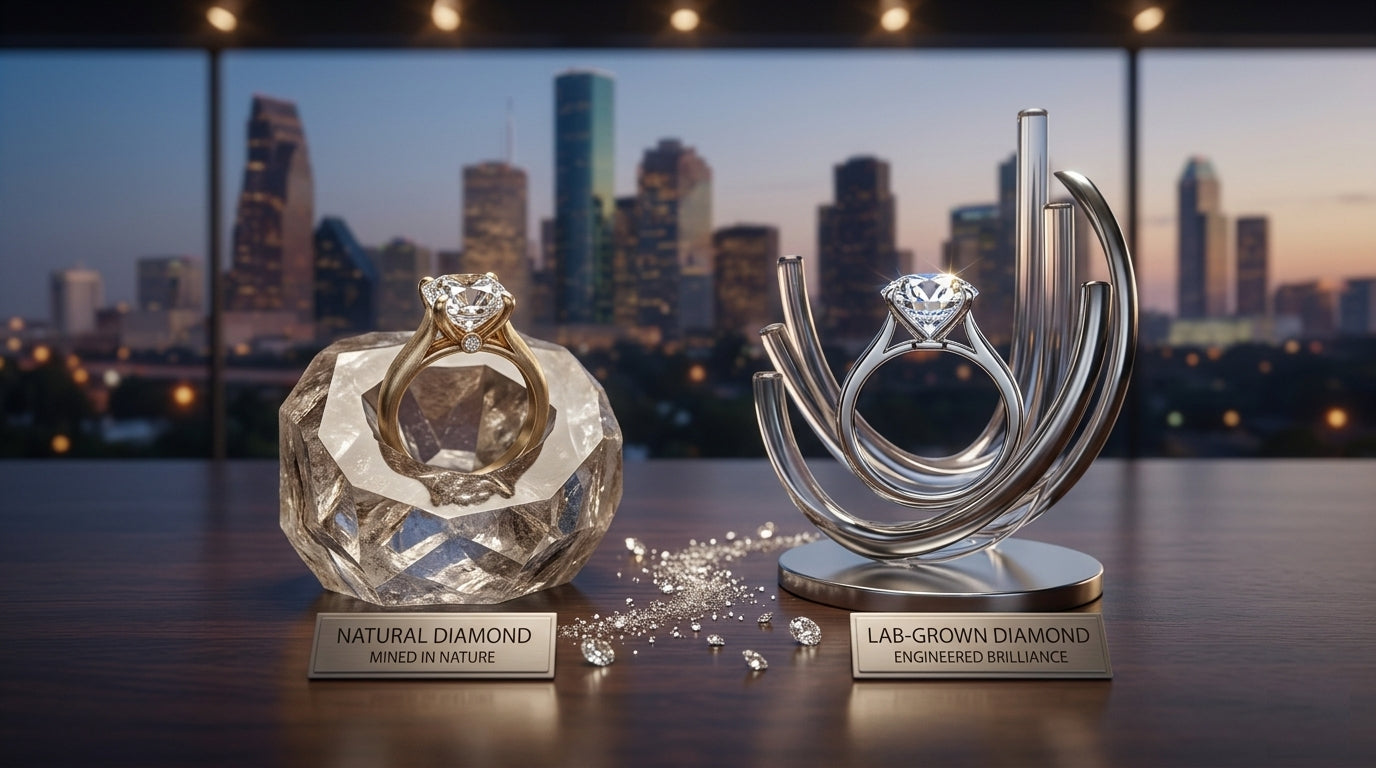
The biggest differences are origin, rarity, and market dynamics. Natural diamonds formed deep within the earth over billions of years through immense heat and pressure, making each stone a finite product of nature. Their limited supply contributes to their rarity and emotional significance for many buyers.
Lab-grown diamonds are created in controlled environments using advanced technology that replicates these same conditions in a matter of weeks. Because they can be produced as demand increases, lab-grown diamonds often make larger sizes and higher color or clarity grades more accessible within a given budget.
For some people, the romance of owning something formed naturally over billions of years is important. Others prefer maximizing size and quality within their budget. Neither choice is wrong and the right choice depends entirely on your priorities.
Why Are Lab-Grown Diamond Prices Lower?
One of the biggest reasons couples choose lab-grown diamonds in Houston is price. A lab-grown diamond can cost significantly less than a comparable natural diamond of the same size, color, and clarity. This allows buyers to purchase a larger center stone or allocate more of their budget toward the setting, wedding expenses, or other financial goals.
The lower price of lab-grown diamonds is largely due to increasing production capacity and technological advancements. As more diamonds can be created, supply has increased and prices have generally become more affordable over time. Like many forms of technology, lab-grown diamond prices have fallen significantly over the past several years as manufacturing processes have improved and production has expanded.
Natural diamonds operate within a different market because their supply is inherently limited by nature. Additionally, diamond mining companies help manage pricing by carefully controlling supply. This is a similar business model for many luxury brands.
For many couples, the question isn't which option is better but which option better aligns with their budget and long-term goals.
What Is the Resale Value of Lab-Grown Diamonds?
One of the most common questions we hear involves lab-grown diamond resale value. The truth is that most diamonds (both natural or lab-grown) should not be purchased as financial investments. Engagement rings are primarily emotional purchases that symbolize a relationship and a lifelong commitment.
That said, natural diamonds have historically maintained stronger secondary-market demand over the long term due to their rarity and finite supply. Lab-grown diamonds have experienced substantial price reductions over the past several years as production has increased worldwide. Because of this, consumers should know that there is little to no re-sale value.
If long-term value retention is one of your highest priorities, a natural diamond may be the better fit. If maximizing beauty and size within a budget is more important, a lab-grown diamond can provide exceptional value.
Which Diamond Is Right for You?
A natural diamond may be the best choice if:
-
Rarity matters to you.
-
You appreciate a diamond's natural origin and history.
-
Long-term value retention is important, including the ability to pass it down to future generations.
-
You want something natural that formed over billions of years.
A lab-grown diamond may be the best choice if:
-
Maximizing size within your budget is a priority.
-
You want higher color and clarity grades for less money.
-
You prefer a manufactured origin.
-
You want more flexibility in your overall engagement ring budget.
AtDubin's Fine Jewelry, we believe education comes first. We proudly offer both natural and lab-grown diamonds because every couple has different goals, preferences, and priorities.
Looking for Lab-Grown Diamonds in Houston?
Whether you're interested in acustom engagement ring, comparing natural and lab-grown diamonds, or simply want honest guidance, we're here to help. Our private showroom near The Galleria offers one-on-one consultations where you can view both options side by side, ask questions, and make an informed decision without pressure.
Ready to get started?Book a private appointment with our team or begin designing your dream ring using our online ring builder.
Frequently Asked Questions
Are lab-grown diamonds real?
Yes. Lab-grown diamonds are real diamonds with the same chemical and physical properties as natural diamonds. The primary difference is that they are created in a laboratory rather than formed naturally within the earth.
Do lab-grown diamonds hold their value?
Lab-grown diamonds do not retain value because production can increase as demand grows. Neither natural nor lab-grown diamonds should be viewed primarily as investments.
Why are lab-grown diamonds cheaper?
Lab-grown diamonds are generally less expensive because technological advancements and increased production have made them more readily available. Natural diamonds remain finite and are subject to different supply dynamics.
Can you tell the difference between natural and lab-grown diamonds?
Without specialized equipment, even experienced jewelers cannot reliably distinguish between natural and lab-grown diamonds by sight alone. Laboratory testing is typically required.
Should I buy a natural or lab-grown diamond?
The right choice depends on your priorities. Natural diamonds offer rarity and natural origin, while lab-grown diamonds often provide greater size and quality for the same budget. At Dubin’s Fine Jewelry, you will find thelatest collection of diamond jewelry that will perfectly fit in your budget.